
The Index of Industrial Production for the same month last year stood at 12 per cent. For the first half of the current fiscal (April-September 2007) too, IIP slipped to 9.2 per cent against 11.1 per cent in the corresponding period a year ago, an official release said on Monday. During September, the manufacturing sector growth decelerated to 6.6 per cent as compared to 12.7 per cent in the same month last year.

Showing signs of recovery, industrial production grew at 4.7 per cent in May, the highest since October 2012, on account of improved performance of manufacturing, mining and power sectors and higher output of capital goods.
Manufacturing sector pushes IIP up 3.7% in Nov

India's industrial production slipped to an 18-month low, contracting by 0.8 per cent in August, mainly due to a decline in output of the manufacturing and mining sectors, according to official data released on Wednesday. The data showed that the previous low in industrial output growth was a contraction of 3.2 per cent in February 2021. Factory output, measured in terms of the Index of Industrial Production (IIP), had expanded by 13 per cent in August 2021. The IIP grew by 2.2 per cent in July this year.

Eight core sector industries recorded a growth of 5.5 per cent in February, the highest in 11 months, mainly due to healthy expansion in output of coal, refinery products and electricity, according to a government data released on Tuesday. The eight core sector industries -- coal, crude oil, natural gas, refinery products, fertiliser, steel, cement and electricity -- had expanded by 2.2 per cent in February last year.
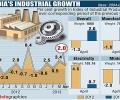
Industrial production, measured by the index of industrial production, slowed to a 20 month low of 1.6 per cent in December, from 2.7 per cent in November 2010.

According to a statement available on the Ministry of Statistics and Programme Implementation website, gross domestic product, consumer price index and index of industrial production will now be released at 5.30 in the evening.

Due to lower output from mines, utilities and factories, the July factory output data came down to 0.5 per cent year-on-year, the government data showed on Friday, down from June's revised 3.9 per cent rise.

There is a significant amount of dispersion in the growth rates across different industries.

The task force was set up in July 2011. Although the industrial production during March improved to 2.5 per cent, the factory output during 2012-13 worked out to be only 1 per cent, down from 2.9 per cent in the previous fiscal.

Slow growth in key sectors would also have implications on the Index of Industrial Production (IIP) number as these segments account for about 41 per cent to the total factory output.

Slow growth in the key sectors would have implications on the IIP number as these segments account for about 41 per cent of the total factory output.

Large sectors such as metals, mining, machinery, and transportation have seen a decline.

Retail inflation declined to an 18-month low of 4.7 per cent in April mainly due to falling prices of vegetables, oils and fats, and came closer to Reserve Bank's target of 4 per cent, showed government data released Friday. It was for the second month in a row that Consumer Price Index (CPI) based inflation remained within the RBI's comfort zone of below 6 per cent. The government has tasked the central bank to ensure retail inflation remains at 4 per cent with a margin of 2 per cent on either side.

Production of eight infrastructure sectors expanded by 7.9 per cent in September -- the highest in three months -- on account of better show by coal, fertiliser, cement and electricity segments, according to official data released on Monday. In September last year, the growth rate stood at 5.4 per cent. It was 4.1 per cent in August. The previous high was in June when the output expanded by 13.1 per cent.

The manufacturing sector, which accounts for over 75 per cent of the index, declined by 2.4 per cent against a growth of 4.1 per cent in December 2014.

Manufacturing sector, which constitutes over 75 per cent of the index, grew at 5.5 per cent in November compared to a decline in output by 4.6 per cent earlier

Coal, crude oil, natural gas, cement, and electricity recorded a negative growth of 8.6 per cent, 5.4 per cent , 3.9 per cent, 4.9 per cent and 2.9 per cent, respectively, in August.

The sharp rise was also due to a statistical illusion -- low industrial numbers in November 2015, and sharp reversal of a 12-month declining trend in capital goods.

Sluggish infrastructure sector growth would also have impact on IIP as these segments account for about 41 per cent of the total factory output.

The NCEAR has indicated some improvement in the fourth quarter of the current financial year.
The Index of Industrial Production (IIP) grew by 1.4 per cent in November as most components like manufacturing, electricity, mining, primary goods, and consumer durables witnessed a slowdown, according to data released by the National Statistical Office (NSO) on Wednesday. This is on the base of a decline of 1.7 per cent in November 2020 and before the new Covid variant started impacting economic activity. IIP growth was lower than the 4 per cent expansion recorded in the previous month but was better than a 1.6 per cent contraction seen in November 2020. Separately, rising prices of kitchen staples pushed retail inflation, or rate of price increase, to 5.59 per cent in December 2021, bringing it close to the upper band of Reserve Bank's comfort zone.

The greatest disconnect lies in the estimates of industrial growth.

The manufacturing sector, which constitute more than 77 per cent of the index, recorded a growth of 5.2 per cent in April, up from 2.9 per cent in the year ago month.
Although the mining and electricity sectors did better in May, manufacturing fared poorly in the month with the growth rate decelerating to 11.9 per cent from 13.3 per cent during the corresponding month in 2006-07.

IIP is expected to post a subdued volume growth in February 2017
In twin blows to Indian economic revival, higher food prices drove retail inflation to a five-month high of 7.4 per cent while factory output fell for the first time in 18 months. The second consecutive month of rise in consumer price index (CPI)-based inflation will add to the pressure on the Reserve Bank of India (RBI) to again raise interest rates to tame high prices. Inflation has been above the targeted zone for the ninth month in a row and as per statute, the RBI will now have to explain to the government in writing why it failed to keep prices below 6 per cent.
Industrial production growth slowed down to five-month low of 0.4 per cent in August mainly due contraction in manufacturing output and lower offtake of consumer goods.
The fiscal 2008-09 began on somber note with industrial growth in April dropping to 7 per cent compared to 11.3 per cent in the same month a year ago, reflecting the impact of higher interest rates and rising input costs.The performance in April, however, was much better than the 3.9 per cent growth rate witnessed during March, the last month of the previous fiscal, according the Index of Industrial Production (IIP) data released on Thursday.
India's industrial growth has been crawling below five per cent for months now and overall economic growth has moderated to a two-year low of 6.9 per cent in the second quarter of this financial year, say the statistics.

According to the Central Statistical Organisation data, released earlier in the day, Index of Industrial Production grew by 16.7 per cent in January against just a per cent during the corresponding month in 2009.

In a double delight, retail inflation eased to a one-year low of 5.72 per cent - staying below the upper tolerance limit for two months in a row, while factory output rose sharply to 7.2 per cent on the back of healthy growth in manufacturing. The retail inflation numbers based on Consumer Price Index (CPI) will provide some room for the Reserve Bank to further moderate the quantum of hike in key interest rate or even press a pause button. The RBI has been on a rate hiking spree since May 2022 in its bid to tame inflation, having raised the repo rate by a cumulative 225 basis points (bps).
Vivek Mahajan (Head - Research) Aditya Birla Money, analysed the slow IIP growth.

The economy may grow by around 7 per cent this financial year as estimated by the Monetary Policy Committee (MPC) of the Reserve Bank of India (RBI), say economists with various organisations. The first advance estimates for 2023-24 will be released on Friday by the National Statistical Organisation (NSO), an exercise done for calculating ratios such as the fiscal deficit. The interim Budget will be presented on February 1.

On the impact of declining industrial production on economic growth, he said "the growth rate for the current fiscal will be between 5.5 per cent or 6 per cent. Perhaps 5.7 per cent is the likelihood".

Progress on monsoons along with favourable base effect in 2HFY2017 continues to point towards RBI achieving its near 5 per cent inflation target by the year-end
Industrial production growth rate has declined to 7.6%, due to dismal performance by manufacturing, mining and electricity sectors.

The other prominent gainers were Tech Mahindra, HCL Technologies, Wipro, State Bank of India and Larsen & Toubro. Bajaj Finserv, Power Grid, UltraTech Cement and HDFC Bank were among the laggards.

The output of eight infrastructure sectors registered a growth of 3.6 per cent in March 2023, the slowest in five months, showed government data released on Friday. The output of core sectors had increased by 7.2 per cent in February 2023 and 4.8 per cent in the year-ago month. The previous low was 0.7 per cent in October 2022.

Crude oil, fertiliser and cement recorded negative growth
